
Want to Work in This Space?

If you've found your way here, chances are you've already noticed the gap. Maybe a client walked in carrying something you didn't quite have the language for. Maybe you left your own training realising it never touched this at all. Maybe you've simply felt the pull toward this work and you're not sure where to begin.
Wherever you're starting from, this page is for you. It's a map of the pathways we offer and point people toward. There's no single right order to work through any of it. Start where you are, and follow what feels relevant.
Who Is This For?
Students who are just getting curious
Newly qualified practitioners finding their footing
Experienced clinicians wanting to specialise

Start With the Foundations
Before anything else, it helps to build a solid grounding in what religious trauma actually is, how it shows up, and why it's so often missed.
Two trainings from RTC co-director Sam Sellers (through Anchored Counselling Services) are a good place to begin:
Understanding Religious Trauma: the foundational lens. Religious trauma as a contextual injury rather than a pathology, and why leaving is rarely "just leaving."
Religious Trauma & The LGBTQIA+ Community: deepening the work where identity and harm intersect, and where well-meaning practice can still replicate harm.
You can take these separately, or together as a bundle. There's also a bundle option that includes supervision sessions, if you'd like space to integrate the work rather than only learn it.
Go Deeper With Our Resources
Our resource library is there for the in-between moments, when you want to read up on something specific, deepen your understanding, or find something to sit with between clients. It's a growing collection covering the concepts, dynamics, and language that shape this work.
Worth starting with our recent three-hour practitioner orientation to cult recovery work, available as a full recording. It covers what this population actually is, why it gets missed in clinical settings, how it presents, where it gets misdiagnosed, and the ethics and scope questions specific to this work. CPD certificate included, and it's yours to revisit whenever you need to.
If you're early in your journey, the library is a low-pressure place to start. If you're further along, it's a useful reference to keep returning to.
Looking for a Book, a Podcast, or Something to Watch?
Sometimes the most useful thing is a book to read on the train, a podcast for the drive home, or a documentary to sit with on a quiet night. We keep dedicated lists of the resources we come back to and recommend, so you're not trying to work out what's worth your time on your own. You can check out books, podcasts, documentaries and articles/blogs.
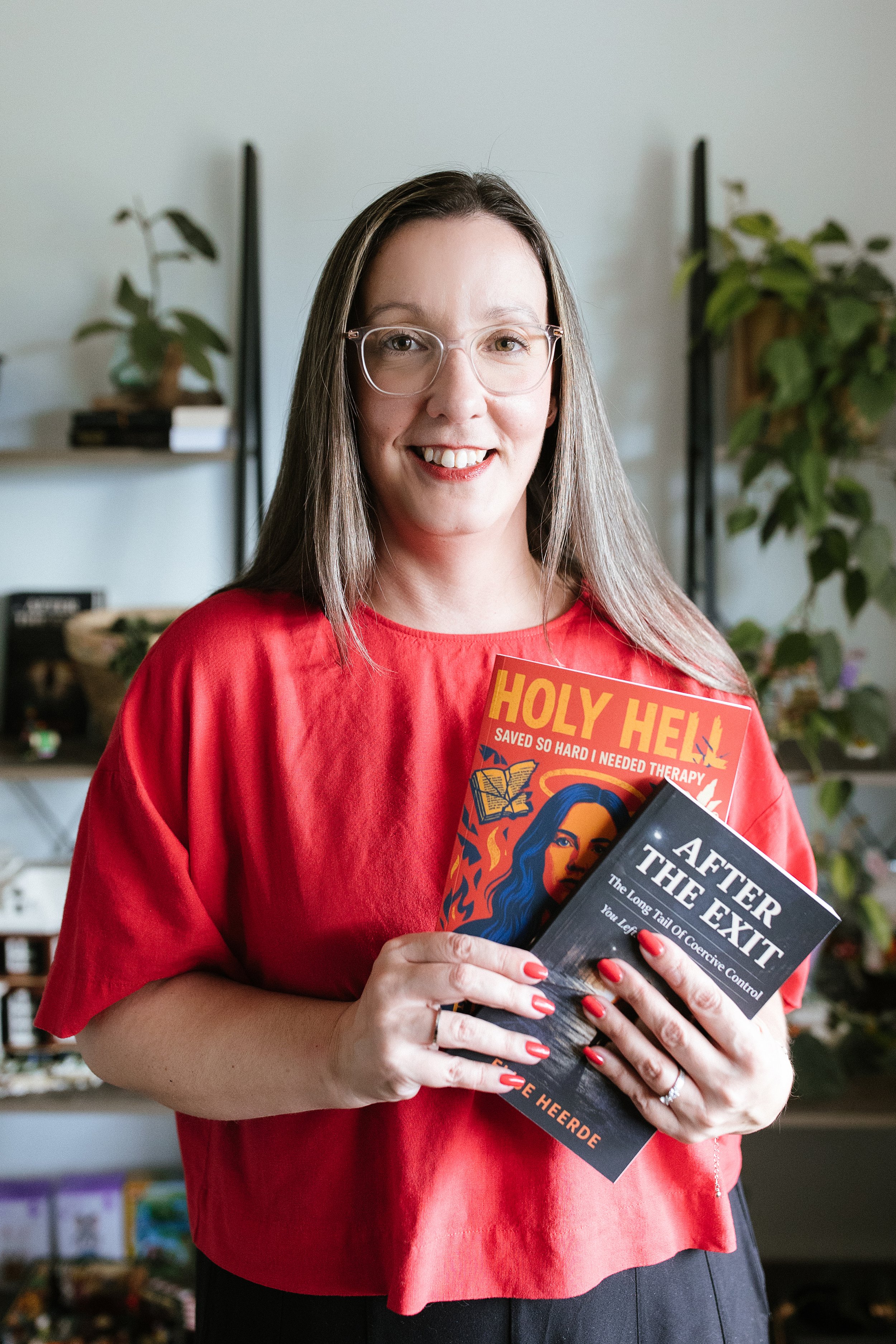
A particular mention for the books written by RTC co-director Elise Heerde.
Holy Hell: Saved So Hard I Needed Therapy is her memoir of years inside high-control Pentecostal Christianity, honest, sharp, and often funny.
After the Exit: The Long Tail of Coercive Control picks up the part that often gets missed, the slow work of recovery and the ways coercive control keeps its grip long after someone has left.

Don't Do This Work Alone
This work is heavy, and it's not meant to be carried in isolation. We offer a few ways to stay connected and supported:
Group Supervision: a facilitated space to bring real client scenarios, work through the stuck points, and reflect on your own positioning and responses alongside others doing the same work.
Lunch and Learns: shorter, informal sessions to keep learning, stay current, and connect with a community of practitioners who get it.
Both are about making sure you're supported, sharpening your practice, and not sitting alone with hard material.
Join us at the Annual Event
Once a year, we bring everything together in our online event. Three days of sessions spanning survivor experience, clinical expertise, and the wider conversations shaping this field. The All-Access Pass gives you the full program to watch and revisit in your own time.
It's one of the best ways to immerse yourself, hear from a wide range of voices, and get a sense of the whole landscape in one place.

Cult Recovery Training
Coming early 2027
Our flagship Cult Recovery Training is in development.
A comprehensive, in-depth program built specifically for the gap that mainstream training leaves behind. It covers the full scope of working with survivors of religious and non-religious high-control groups alike, from the frameworks through to the clinical and ethical realities of the work.
If this is the work you want to do properly, this is what to keep an eye out for.
Register your interest for launch updates and introductory pricing.
Where This Can Lead: The Practitioner Directory
As you build your knowledge and experience in this space, joining our Practitioner Directory may be the natural next step.
It's how survivors across Australia and New Zealand find practitioners who genuinely understand religious trauma and high-control group recovery, and it's where a lot of this work leads once you're practising with confidence.
Listing does involve meeting our criteria and an approval process, which we've built to keep the directory something survivors can trust. If that's a direction you're working toward, it's worth knowing where you're headed.
Not Sure Where to Start?
That's completely normal, and you're welcome to reach out.
We're always happy to point you toward whatever fits where you're at, whether that's a single training, a supervision space, or just a conversation about the work.