
What We Mean When We Say ‘Cult’?
“A cult is a group, religious organization or family structure of any size led by a charismatic leader. Cults control their members through manipulation, abuse, and coercion. These groups feature transcendent belief systems, and create self-sealing systems from which followers find it difficult to escape.”
Dr Janja Lalich, a leading expert on coercive control and cult dynamics

The Lalich Center identifies seven key elements that define cultic (or totalistic) groups:
Authoritarian leadership
All-consuming belief system
Mind-altering practices
Excessive demands on time and loyalty
Isolation from outside life
Fear of leaving
A self-sealing, closed belief environment
I Think I’m In A Cult
If you’re starting to wonder whether the group you’ve been part of might be a cult -or if you know it was but still feel conflicted.
We want you know that you’re not alone.
Maybe your experience was in a spiritual community, a self-help group, a wellness movement, or something that didn’t call itself “religion” at all.
If it controlled how you thought, behaved, related, or believed and punished your autonomy then this space is for you too.
You may feel torn, confused, scared, or guilty.
That’s not weakness. That’s what it looks like when coercion meets your humanity.
It’s okay to ask questions.
It’s okay to feel unsure.
It’s okay to stay silent, or to speak up, at your own pace.
It’s okay to grieve something that was both harmful and meaningful.
You don’t need the perfect label to begin recovering your autonomy.
Whether you called it church, community, family, or something else entirely - we’re here for survivors at every stage: questioning, leaving, recovering, and rebuilding.
If you need support contact one of our cult recovery specialists.
Not All Cults Are Religious
Not all cults are religious.
Many operate in other high-control spaces like:
Wellness communities
Meditation groups
Self-development empires
Political movements
High-demand MLMs or family systems
Cults can also be in all difference size groups as well as 1:1 cults.
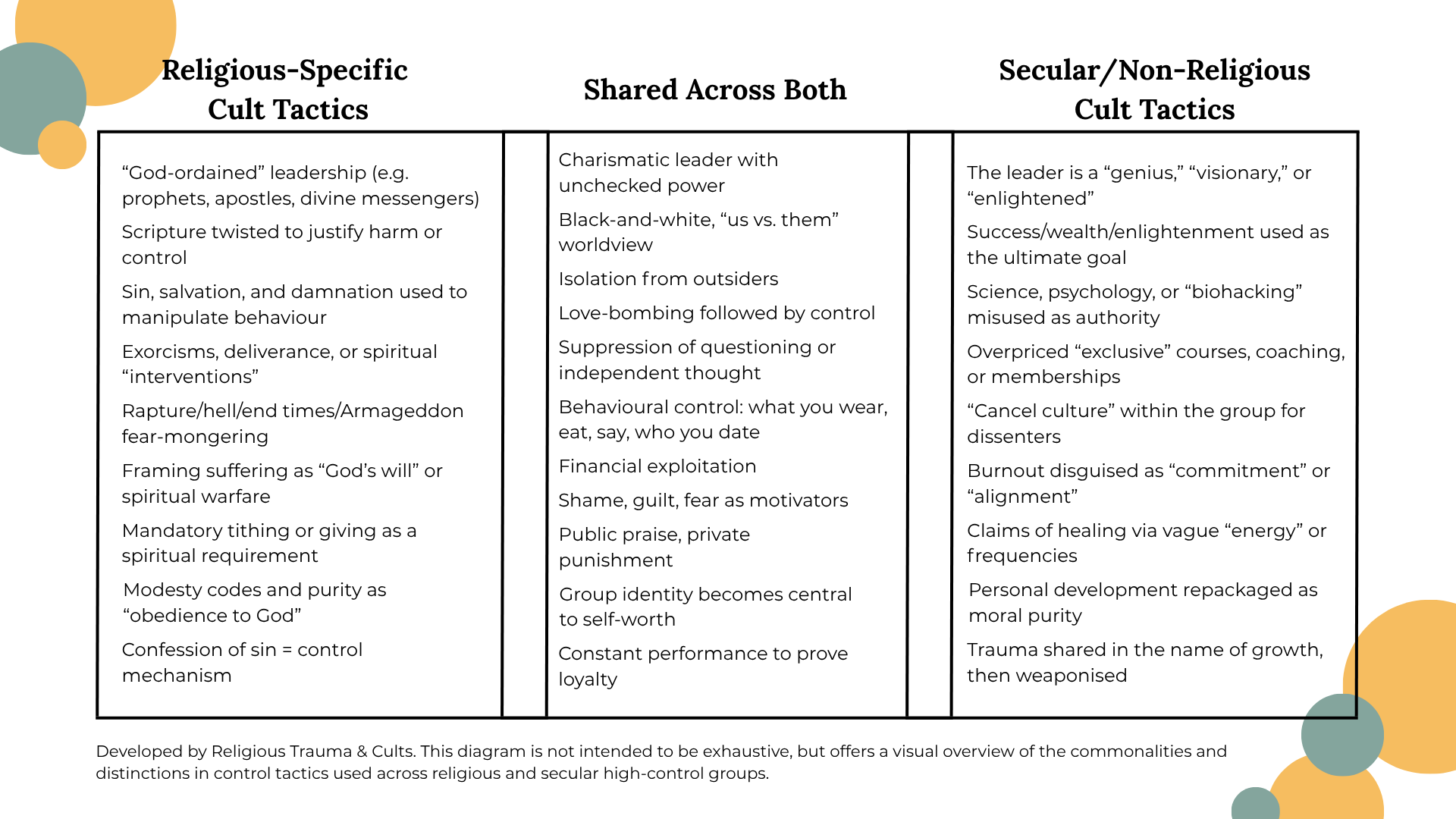
What they have in common is not belief, but behaviour.
They use control tactics to dominate how people think, feel, act, and relate. We have created a visual to show the overlaps below.

Am I In A Cult?
It’s not always obvious. That’s why we love Renée Spencer’s Cult Ranking System, a practical tool for assessing the level of coercion and control you may have experienced in a group, relationship, or environment.
Her framework outlines a scale that ranges from:
Level 0: A safe, autonomous group with healthy boundaries
Level 10: An extremely destructive cult, marked by high levels of fear, isolation, psychological abuse, and total control
This system helps break down how a group operates rather than focusing solely on what it believes. It considers behavioural patterns like manipulation, obedience to authority, punishment for dissent, and loss of personal agency.
This tool is especially helpful if you’re unsure how to name your experience, or if you want language and validation for something that felt “off,” but was hard to explain.
Note: The scale is not diagnostic. It’s intended as an indicative tool to support insight, reflection, and recovery.
A Note on Cult Pseudo-Personality
One of the most significant and under-recognised aspects of cult involvement is what Dr. Gillie Jenkinson, award-winning psychotherapist, researcher, and author of Walking Free from the Trauma of Coercive, Cultic and Spiritual Abuse, describes as cult pseudo-personality.
Jenkinson outlines how coercive systems overlay a foreign identity onto individuals, and offers a recovery process that encourages survivors to work through and digest these imposed elements in order to reclaim their genuine sense of self.
In other words, what a cult does to a person goes far deeper than changing their beliefs. It reshapes who they understand themselves to be. Recovery is not just about leaving. It is about reclaiming the self that was there before, and building a life on ground that actually belongs to you.


Victorian Parliamentary Inquiry into Cults & Fringe Groups
A landmark moment in Australian advocacy:
The Victorian Parliamentary Inquiry into the Recruitment and Impact of Cults and Other Fringe Groups is underway with the final report due to be handed down by September 2026.
The Committee is looking into cults and fringe groups in Victoria - how they recruit and control people - and will report back by 30 September 2026. This inquiry is not about judging anyone’s beliefs, it’s about protecting people from harm. We want to understand whether current laws are strong enough to deal with groups that use manipulation or control in ways that can seriously hurt people.
Some of the common behaviours or actions they are looking at are:
Isolating members from friends and family
Demanding total obedience and punishing members for perceived disobedience
Using guilt or fear to control thinking
Suppressing individuality
Abusive behaviours, including financial, psychological, physical and/or sexual abuse
Other coercive control behaviours