Who Is RTC?
Religious Trauma and Cults, (formally The Religious Trauma Collective) was founded in 2024. Founded by practitioners who had both lived experience and worked at the intersection of religious harm, coercive control, and the complicated, nonlinear process of recovering from a group that used control as currency.
We started with religious trauma because that's where our experience sat. But it didn't take long to see that the people finding their way to us weren't all coming from churches. They were coming from wellness communities, network marketing organisations, family systems, political movements, therapeutic settings, and spaces with no religious identity at all.
What they shared wasn't a doctrine. It was the experience of having their autonomy dismantled, their thinking shaped, and the cost of leaving made to feel unsurvivable.
Coercive control doesn't require religion.
It requires a system, or a person, willing to use power to keep people compliant. It causes real, lasting, complex harm regardless of what name was on the door.
The Expansion…
We expanded not away from religious trauma because that work is as important as it ever has been, but outward, to hold the full spectrum of what coercive control looks like and who it affects.
We renamed it to Religious Trauma and Cults because we wanted our name to say what we actually do. And our tagline to mean what we actually believe:
No group is exempt. No survivor is excluded.
RTC exists to resource survivors, equip practitioners, and build a professional field that takes this work seriously. We do that through our practitioner registry, our training programs, our annual event, our support groups, our resources, and our ongoing advocacy at a systemic level.
We are based in Australia and New Zealand, and we understand that the cultural backdrop here shapes how high-control harm is experienced, named, and navigated.
But the reach of this work has never been limited by geography.
Survivors and practitioners from across the globe are part of what we are building, and we remain deeply connected to the international field - contributing to it, learning from it, and advocating within it.
We understand this work from the inside both professionally and personally, and that shapes everything about how we approach it.
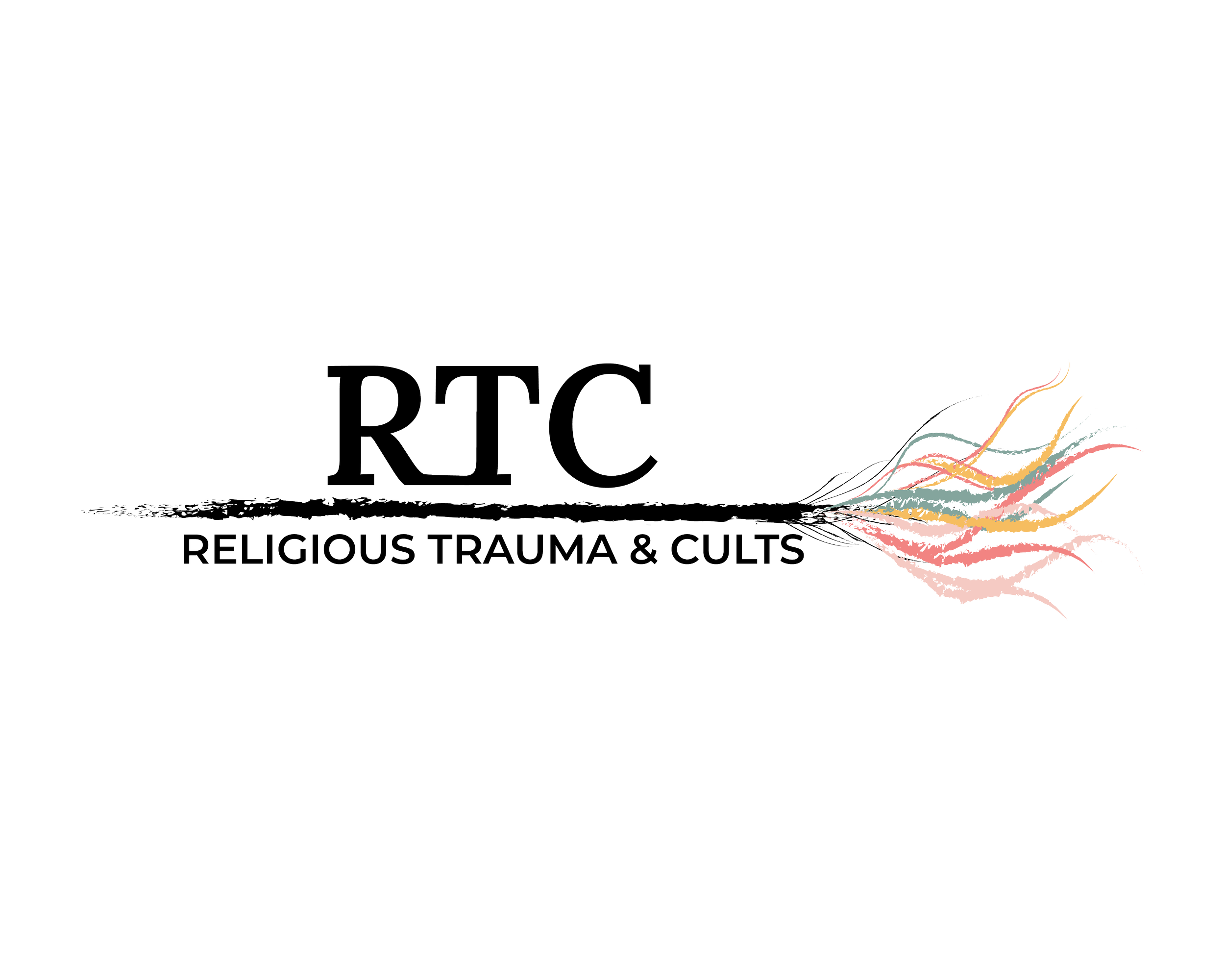
Our New Logo
Recovery isn't clean. That's something we've always known, and it's something we wanted our logo to hold without flinching.
A single black thread runs through the mark. It's rough-edged, textured, not a clean printed line, but something that looks worn and real. It begins frayed and ends frayed, and in between, it opens into strands of colour. Not replacing the black. Carrying it through.
That residue is intentional. The dark threads bleed into the colour because recovery doesn't leave the hard things behind. It weaves them into who you become. The logo pushes back quietly against the pressure survivors so often face, to perform full transformation, to appear unblemished, to leave the past cleanly in the past.
The fraying at both ends holds two experiences at once. For those who came to a high-control group already undone; no stable self before it, no clean origin the thread begins damaged. There was no intact before. For those born or raised inside, who had no prior self to return to, the strands at the other end aren't a homecoming. They're a first becoming. A self forming, perhaps for the first time.
Same image. Two entirely different journeys. Both held without hierarchy.
That's what we wanted this logo to carry. The full, unsanitised landscape of what this work actually holds and what recovery, in reality, actually looks like.
What We Are…
Practitioners with lived experience who understand this work from the inside, not just the outside.
Committed to naming coercive control and high-control harm across every context, religious or not.
A professional home for practitioners in Australia and New Zealand working with religious trauma, cult recovery, and high-control group harm.
Advocates for survivors at a systemic level.
Dedicated to building resources, training, and infrastructure that didn't exist before.
Deeply committed to affirming and including LGBTQIA+ survivors, whose experiences of religious harm carry particular layers of complexity and pain.
Mindful that we do this work on the lands of Aboriginal and Torres Strait Islander peoples and Māori as tangata whenua of Aotearoa, and that the harm done to Indigenous communities in the name of religion is not history, it is ongoing. We name it, we do not look away from it, and we hold it as part of why this work matters.
Honest about what we know and what we are still learning.
What We Are Not…
We are not anti-religion, anti-faith, or anti-spirituality. We are anti-harm. People can and do have meaningful, healthy experiences of faith and spirituality, and that is not what we are here to critique.
We are not a crisis service. If you are in immediate need of support, please reach out to a mental health professional or crisis line.
We are not spokespeople for every issue, event, or public conversation related to religious trauma or coercive control, and we are deliberate about that. We are across the landscape, we follow what is happening in the field closely, and we have views. But we are a small team and we choose carefully where we place our voice so that when we do speak, it carries weight.
We are not experts in everything. This is a broad, complex, and evolving field and we are committed to learning alongside it.
We are not a fully resourced organisation available around the clock, but we will always endeavour to respond to any communication within 48 hours.